


Kasurinen observed that the gunplay in the original Control made players intuitively want to put some distance between themselves and enemies, something that the emphasis on melee combat in Control Resonant reverses. The early build that we played handles that change well, with Dylan darting from target to target and using a variety of attacks to deal damage with his shape-shifting weapon. Mastering these techniques, which didn’t take us long, turns Dylan into a paranatural murder machine, stacking up damage significantly as he flits between monstrous opponents.
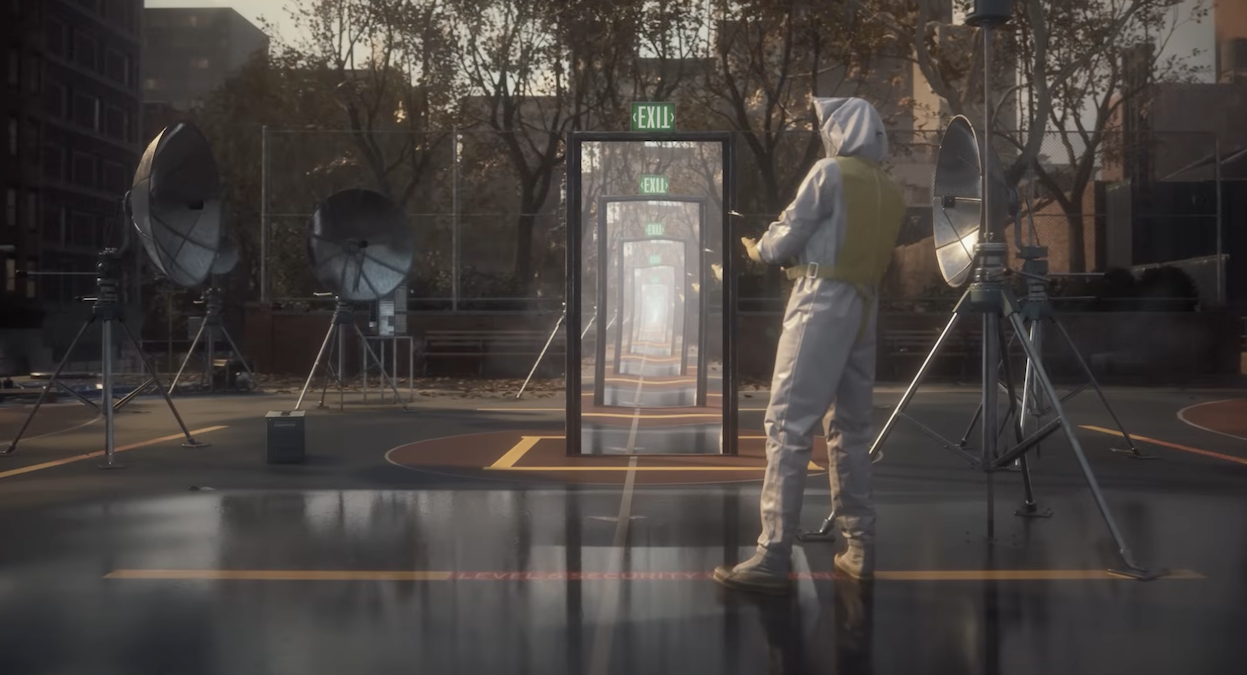
That movement is bolstered by paranatural abilities that Dylan receives relatively early on in Control Resonant after escaping from the Oldest House. These powers are unlocked by venturing into cracks in reality, known as faults, and we received several new abilities in short order even in our early build. But in contrast to the bright and organized faults that Jesse experienced, Dylan’s faults are shadowy expanses with overgrown urban environments to traverse. This design difference is one that reflects the Faden siblings’ personalities along with Dylan’s underlying attempt to reestablish his humanity and connection after years of solitary confinement.
“It’s not an accident that the first game takes place in Oldest House, with a brutalist architectural style that’s all about form, simplicity, and things organized in a deliberate manner,” Kasurinen observes. “In Control Resonant with Dylan, it’s entering a world full of human chaos. Things are there as a consequence of the chaotic environments that we have in our everyday lives.”
In the Control Resonant demo, Dylan sets out to find his sister while defending New York from monsters escaping into his world, with his search driving the narrative forward. This follows a tease for the sequel contained in the DLC to Alan Wake 2, underscoring the shared universe elements between the two franchises. But while there is a level of interconnectivity, Kasurinen emphasizes that Control Resonant offers a fun and satisfying standalone experience, even for those who didn’t play the original 2019 game.
“We are very aware that we have this large universe but that makes it more important that every game that we do can stand on its own two feet. They each have their own story, premise, and you need to be satisfied with that package once you’re done with it. That’s absolutely necessary,” Kasurinen notes. “From a storytelling side, we don’t want it to feel like a massive puzzle that you can’t fully understand until you play all of the games.”
Just as Control rethought what was possible for a third-person shooter, Control Resonant takes those core sensibilities and boldly reinvents them through melee combat and a more expansive environment in a corrupted Manhattan. At the same time, the sequel is still so distinctly a Control game, maintaining the first game’s underlying aesthetic of “the strange colliding with the mundane” as Kasurinen puts it. With that in mind, the trappings are similar and the narrative foundation is present but Control Resonant completely defies expectations for what a direct sequel should be, continuing Remedy’s reputation as one of the most unique studios putting out refreshingly original games today.


